What Is Meta Analysis in Research?
Learn what is meta-analysis in research, how it works, its key steps, and why it is important in scientific research.
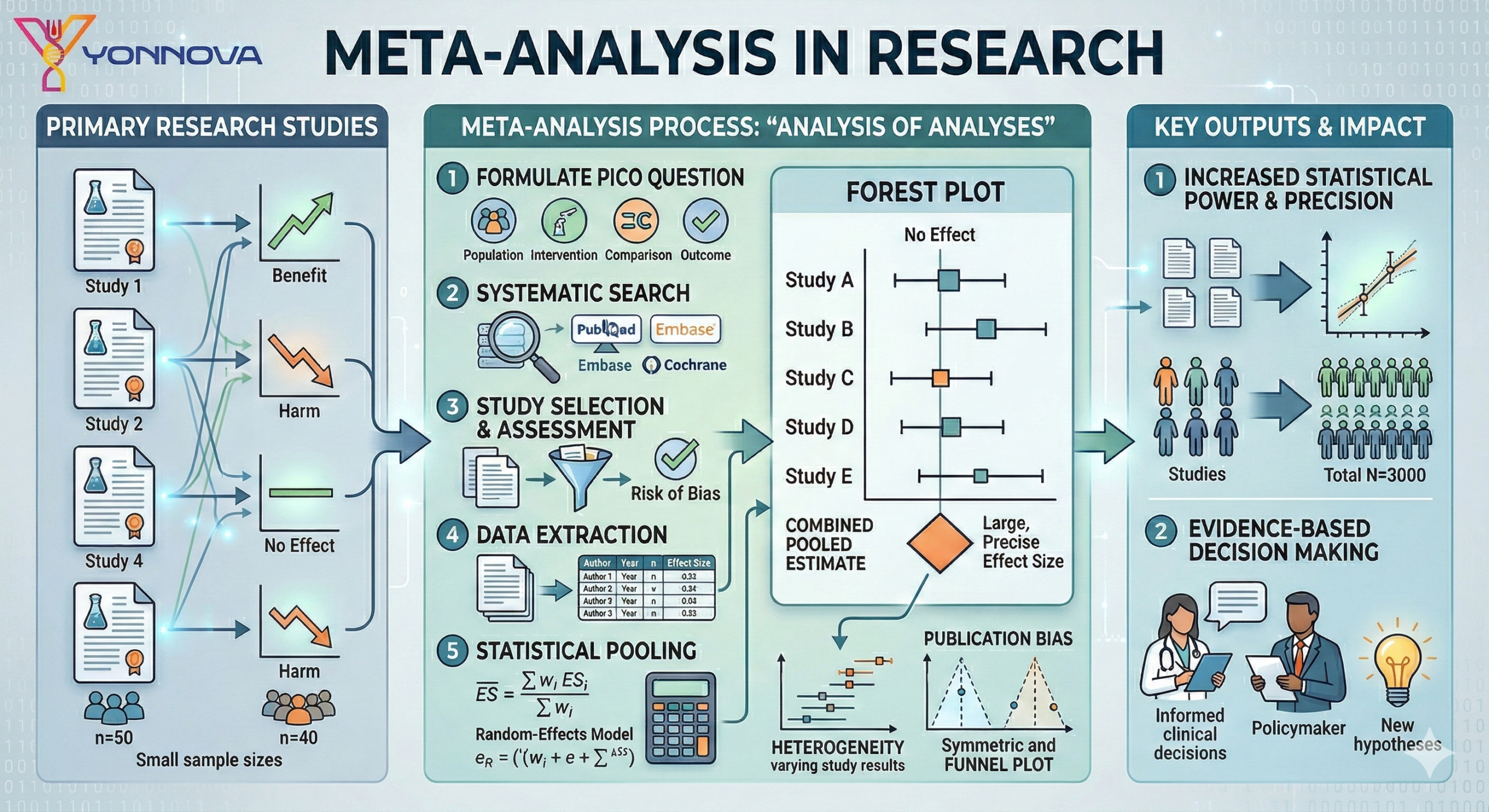
Meta Analysis in Research
A meta-analysis has become an important tool in modern research. It helps scientists and researchers make sense of large amounts of data from different studies. This method brings together results from many studies to give us a clearer picture of what the research tells us.
When researchers want to understand a topic better, they often find many studies with different results. Meta-analysis helps solve this problem by combining all these studies into one strong conclusion. This makes these findings more reliable and useful for making important decisions in medicine, education, medical devices, surgical procedures, and other fields.
The main goal of meta-analysis is to provide better evidence for research questions. It saves time and money by using existing data. Instead of conducting new studies, researchers can analyze past research and identify patterns that individual studies might have missed.
What Is Meta Analysis in Research?
In research, meta-analysis is a statistical method that combines data from multiple independent studies on the same topic. Think of it as putting together pieces of a puzzle. Each study is one piece, and meta-analysis helps to create a complete picture.
The purpose of meta-analysis in scientific and medical research is to:
- Summarize large amounts of data for easy understanding
- Find out if a treatment or method really works
- Make research findings more accurate
The key difference between individual study and meta-analysis research is simple. An individual study examines one group of people or one experiment. A meta-analysis examines many studies together. When you combine ten studies with 100 people each, you now have data from 1,000 people, which makes the findings more trustworthy and robust.
Understanding Meta Analysis Research
Meta-analysis research involves careful work with data from different sources. Researchers must follow strict rules such as PRISMA Guidelines to ensure that the analysis is fair and correct.
Types of Data Used in Meta Analysis Research
A meta-analysis can work with different types of data:
- Numbers from medical trials showing if a treatment works
- Results from surveys and questionnaires scoring
- Measurements like blood pressure, weight, or test scores
- Statistics that show relationships between different factors
The data must come from studies that ask similar questions. For example, if you want to know if a medicine helps with headaches, you would only include studies on that medicine and headaches.
Role of Statistical Methods in Meta Analysis Research
Statistical methods are the backbone of meta-analyses. These methods help researchers combine data fairly. Studies with more people or better quality receive more weight in the final result. This is a weighted average approach.
Common statistical methods include fixed-effects and random-effects models. These help to account for differences between studies and provide the most accurate answer.
Why Meta Analysis Is Used in Research Studies
A meta-analysis offers several important benefits that make it valuable in research.
1. Improved Accuracy and Reliability
When you combine many studies, random errors get cancelled out. The final result is more accurate than outcome of any single study. A meta-analysis can detect small but important effects that individual studies might miss.
2. Resolving Conflicts
Sometimes, different studies show different results. One study might say that a treatment works, while another says that it does not. A meta-analysis looks at all the evidence together and helps determine the truth.
3. Better Use of Resources
Conducting new studies is expensive and time-consuming. Meta-analysis uses existing data, saving time and money. It also helps researchers identify knowledge gaps and determine areas where new studies are needed.
4. Stronger Evidence for Decision Making
Healthcare providers, teachers, and policymakers use meta-analyses to make evidence-based decisions. It provides stronger evidence than single studies, ensuring that decisions are based on the best available evidence.
Meta Analysis Steps in Research
A meta-analysis is conducted using a clear process with five main steps.
Step 1: Defining the Research Question
First, a clear research question should be created based on PICO Framework Guide. This question should be specific and answerable. For example, instead of asking “Does exercise help people?” ask “Does regular exercise reduce heart disease risk in adults?”
Step 2: Identifying and Selecting Relevant Studies
Researchers search databases and libraries such as PubMed, MEDLINE, Embase, Ovid, PROSPERO, Google Scholar, etc. for all studies related to their question. They use specific keywords to find relevant studies. Subsequently, they apply selection rules based on study quality, study population, or study design.
Step 3: Data Extraction from Selected Studies
Once studies are selected, researchers carefully collect data from each study. They record important numbers, such as participant count, reported results, and other key details.
Step 4: Statistical Analysis and Data Synthesis
This is where the actual meta-analysis occurs. Researchers use computer program software such as Review Manager 5, RStudio to combine all data. The programs calculate an overall effect size, showing how strong the relationship or effect is across all studies.
Step 5: Interpretation of Results
The last step is to understand what is the final outcome. Researchers explain the combined results and check if all studies point in the same direction or if there are important differences.
Limitations of Meta Analysis in Research
Although meta-analyses are powerful, researchers must consider their challenges.
1. Common Challenges
A meta-analysis is only as good as the studies it includes. If the original studies had problems, those problems carry over. Different studies might use different methods, making direct comparison difficult.
2. Publication Bias and Data Quality Issues
Publication bias is a serious concern. Studies showing positive results are more likely to be published than studies that find nothing. This means that a meta-analysis might miss important negative results, making treatments appear more effective than they are.
Data quality varies between studies. Some are well designed with many people, whereas others might be smaller or weaker. Researchers must carefully evaluate the quality of each study.
3. Importance of Careful Study Selection
Choosing the right studies is critical. Researchers apply clear inclusion and exclusion criteria at the initial screening stage to ensure only comparable studies are selected. Studies that are too methodologically different are excluded early in the process, ensuring the final analysis is valid.
Conclusion
A meta-analysis is a powerful tool that combines results from multiple studies to generate stronger and more reliable evidence. It helps researchers and decision-makers understand the scientific evidence on important questions in medicine, education, and other fields.
The meta-analysis process involves defining clear questions, identifying relevant studies, carefully extracting data, combining results using statistics, and interpreting findings. Although it has limitations, such as publication bias and data quality concerns, meta-analysis remains one of the best methods for building strong evidence.
By following the proper steps of a meta-analysis and being aware of potential problems, researchers can provide valuable insights that guide practice and policy. As research continues to grow, meta-analysis will remain essential for interpreting available information.
Need Expert Support for Meta Analysis Research?
Conducting high-quality meta-analyses requires strong methodological expertise, accurate data synthesis, and clear result interpretation.
Yonnova Scientific Consultancy provides end-to-end support for researchers, PhD scholars, and healthcare professionals, including:
- Meta-analysis research planning and methodology support
- Study selection and data extraction assistance
- Statistical analysis and result interpretation
- Research writing and publication guidance
If you are planning a meta-analysis study or need expert guidance, Yonnova Scientific Consultancy is here to help.
FAQs
What is a meta-analysis in simple terms?
A meta-analysis is a research method that combines the results of multiple studies on the same topic. It helps researchers reach stronger and more reliable conclusions than a single study.
What is an example of a meta-analysis study?
For example, a study that combine the results from several clinical trials and real-world evidence (RWE) studies to evaluate the efficacy (in the case of RCTs) or effectiveness (in the case of RWE) of a specific drug or treatment. By analyzing all studies together, researchers obtain a clearer overall result. In this way, meta-analysis helps determine the treatment potentiality for curing a particular disease, providing a comprehensive evidence base for clinical decision-making.
Which is better, RCT or meta-analysis?
An RCT provides direct evidence from a single controlled study, whereas a meta-analysis combines evidence from multiple studies. A meta-analysis is stronger when it includes high-quality RCTs.
How do I perform a meta-analysis?
To conduct a meta-analysis, researchers define a research question, select relevant studies, extract data, and statistically combine the results. The findings are then interpreted to draw conclusions.
Is a meta-analysis qualitative or quantitative?
A meta-analysis is primarily a quantitative research method because it uses statistical techniques to combine numerical data from multiple studies.