Literature Based Discovery in Research
Discover what is literature-based discovery in research, its process, core concepts, and how it uncovers hidden connections within existing scientific literature.
Literature Based Discovery in Research: Connecting Knowledge to Create New Ideas
Every day, thousands of new research papers are published worldwide. Although scientists work hard in their own fields, most of them only read papers in their own areas of work. A medical researcher reads medical journals. An environmental scientist reads science papers. Rarely do the two sit together and look for common ground.
This creates a significant problem. Important connections between different studies are often unnoticed. Useful knowledge remains in published papers for years, sometimes decades, without anyone realizing that two separate findings could point to something new and valuable.
This is the problem that Literature-Based Discovery (LBD) helps to solve. It is a method that finds hidden links between separate research studies.
This helps researchers generate new ideas and form new research questions, even without conducting any new experiments.
In modern research, where millions of papers are published every year, no researcher can read everything. Under this condition, the LBD acts as a bridge. It connects knowledge from different areas and turns that connection into a new insight. This makes it one of the most useful tools in current research.
What Is Literature-Based Discovery?
LBD is the process of finding new knowledge by connecting information from various published research papers. These papers may belong to completely different fields and may never have been studied together.
The key idea is simple. Researchers read and analyze existing literature to identify indirect links between findings. These links are not written anywhere. They are hidden between the lines of two or more separate studies. When these links are found and put together, they point toward a new discovery or a new research question.
LBD discovers new knowledge by connecting information that has been explicitly stated in the literature to find connections that have not been explicitly stated.
The Origin of Literature-Based Discovery
The concept of LBD was introduced in the 1980s by a researcher named Dr. Don R. Swanson. He showed that published papers could contain hidden connections that no one had noticed. He proved this by linking two completely separate areas of medical research to suggest a new treatment idea famously connecting fish oil to Raynaud’s disease. His work became the base for how LBD is practiced today.
The core insight was that knowledge that is already published but never connected is called undiscovered public knowledge. LBD brings this knowledge to light.
How Literature-Based Discovery Works
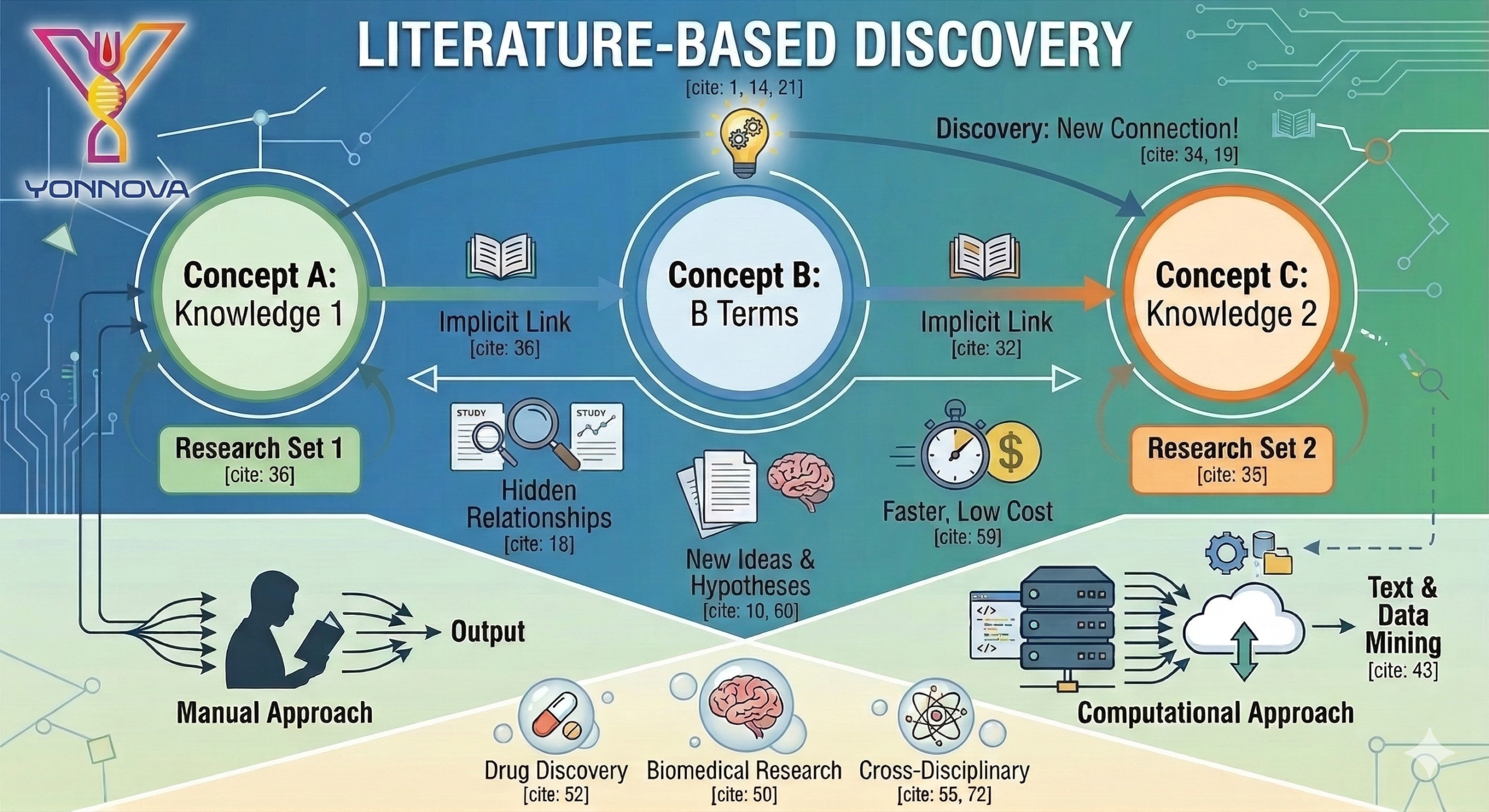
The LBD process follows a clear path. Here is how it works, step by step:
- Step 1: A researcher picks a topic of interest, referred to as concept A.
- Step 2: All research papers linked to concept A are identified, and common themes are extracted. These common themes are called B terms.
- Step 3: They search for papers that discuss those B terms in relation to another area of research, termed concept C.
- Step 4: If A connects to B, and B connects to C, then A may have a meaningful relationship with C, even if no paper has ever said so directly.
This is a well-known A-B-C model of LBD.
The basic assumption of the ABC model is that if entity B is associated with entity A in document set 1 and entity B and entity C in document set 2, the ABC model generates a hypothesis that entity A and entity C have a relation through entity B, which appears commonly in both document sets.
This model is simple to understand but very powerful in practice.
Methods Used in Literature-Based Discovery
Researchers use two main approaches to conduct LBD:
Manual Approach: A researcher reads through many papers and uses their knowledge to identify possible connections. This is time-consuming and depends on the researcher’s expertise.
Computational Approach: This is faster and more common today. It uses Text Mining and Data Mining tools to scan thousands of papers at once. These tools (such as Natural Language Processing (NLP) or Semantic MEDLINE) look for patterns, repeated terms, and statistical links between concepts. They have proven useful in reducing the time needed to find associations that are hidden across vast amounts of scientific literature.
Scientific databases and indexing systems PubMed and Web of Science also play a significant role. They make it possible to search millions of papers in seconds, giving LBD tools the large data sets they need to find meaningful patterns.
Applications of Literature-Based Discovery
LBD has found strong applications in many areas of research:
- Biomedical Research: LBD is widely used to study diseases, genes, and biological processes. This helps scientists understand how different factors interact with each other inside the human body.
- Drug Discovery and Repurposing: One of the most exciting applications of LBD is the discovery of new uses for existing drugs. Instead of creating a completely new drug, researchers can use LBD to discover that a drug already in use might also treat a different condition. This saves time and cost.
- Interdisciplinary Research: LBD helps researchers in different fields find common ground and share useful insights. It has been used in areas such as water purification, social sciences, and materials science and has been linked to several United Nations Sustainable Development Goals (SDGs).
Advantages of Literature-Based Discovery
There are several strong reasons why researchers should use LBD:
- Saves time and cost: Researchers do not need to start from scratch. They build on what is already known.
- Supports hypothesis generation: New research ideas are supported by existing evidence, increasing their credibility.
- Identifies research gaps: LBD can show where knowledge is missing and where more study is needed.
- Encourages innovation: The connection of two separate fields often leads to fresh thinking and new solutions.
- Reduces duplication: Researchers can avoid repeating the work that has already been done and focus on what truly needs exploration.
Research that fills knowledge gaps is often cited more frequently and published in high-impact journals. This shows that LBD-driven work is valued by the broader scientific community.
Conclusion
LBD is a smart and practical approach for generating new research ideas. It works by finding hidden connections between already published studies. Using the A-B-C model, researchers can form new hypotheses without conducting new experiments from scratch.
With the rapid growth of scientific publishing, the amount of undiscovered public knowledge is increasing. LBD helps researchers find what matters most from this large body of information.
As India grows as a major contributor to global research output, tools such as LBD become increasingly important. They allow researchers to accomplish more with existing knowledge, find interdisciplinary links, and push the boundaries of discovery.
In modern research, the LBD is not merely a helpful tool. It is becoming a necessary part of how new knowledge is created.
How Yonnova Scientific Consultancy Can Help
At Yonnova Scientific Consultancy, we support researchers in leveraging LBD to accelerate discovery. Our team helps identify hidden connections across published literature, enabling clients to generate novel hypotheses, explore interdisciplinary opportunities, and strengthen their research pipeline.
Whether you are looking to advance biomedical research, explore new drug repurposing leads, or expand into new fields, Yonnova provides expert-guided LBD services tailored to your research goals.
FAQs
1. What is the main purpose of literature-based discovery?
The main purpose of LBD is to find new knowledge by connecting information from separate unrelated research studies. It helps researchers form new hypotheses and identify hidden relationships without conducting new experiments from scratch.
2. Who introduced the concept of literature-based discovery?
LBD was introduced by Don Swanson in the 1980s. He showed that two unrelated bodies of research could be connected to suggest new scientific insights, which laid the foundation for all the LBD works that followed.
3. What is the ABC model in literature-based discovery?
The ABC model is the most basic and widely used framework in LBD. It states that if concept A is linked to concept B, and concept B is linked to concept C, then A and C may have a meaningful relationship, even if no paper has ever directly stated this connection.
4. Is literature-based discovery used only in medical research?
No, LBD is most common in biomedical research, but it has also been applied in other fields. It has been used in water purification research, social sciences, materials science, and in work related to the United Nations Sustainable Development Goals.
5. What is the difference between open discovery and closed discovery in LBD?
In open discovery, a researcher starts with a known concept and explores what new connections can be found. In closed discovery, both the starting and ending concepts are already known, and the goal is to find a connecting link between them.
6. Can literature-based discovery help in drug repurposing?
Yes, LBD is very useful for drug repurposing. It can identify that a drug already approved for one condition may have potential use in treating another condition, thus saving significant time and cost compared to developing an entirely new drug.