What Are the Types of Literature Review?
Discover what are the types of literature review, including systematic, narrative, scoping, meta-analysis, and more in research.
What Are the Types of Literature Review?
A literature review is a summary and analysis of existing research on a specific topic. It helps researchers understand what has already been studied and where gaps still need to be filled.
When you start any research project, one of the first things you need to do is look at what other researchers have already found. This is exactly what a literature review helps you do. It provides a strong base for building your research.
A well-written literature review demonstrates that you understand your subject. It informs your readers that you have done your homework and that your research is grounded in existing knowledge.
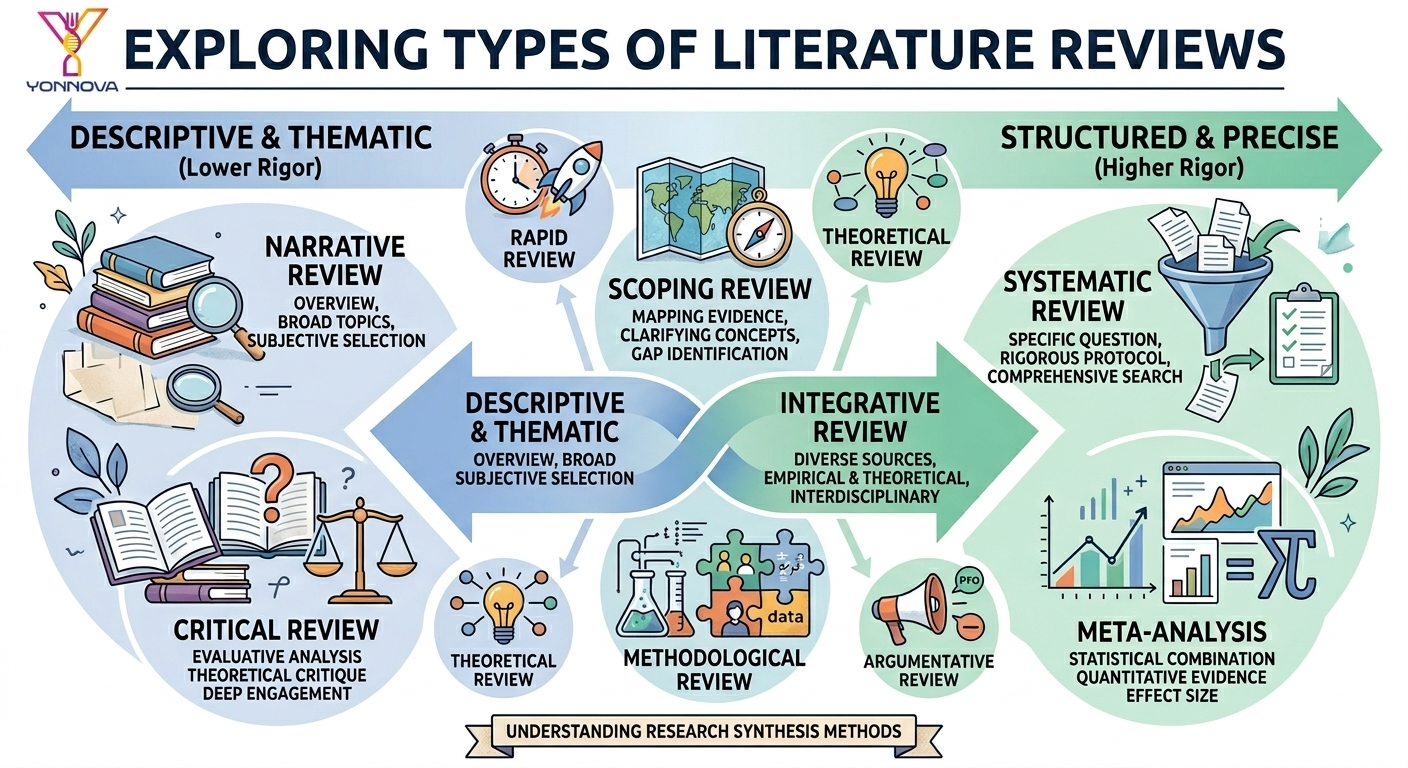
Not all literature reviews are the same. Researchers use different types of literature reviews based on their goals, the depth of analysis needed, and the time and resources they have. Some reviews provide a broad overview, whereas others follow strict steps to gather and compare data from many studies.
Selecting the appropriate type of literature review is as important as writing it well. Choosing the wrong type can lead to weak conclusions or wasted effort. Therefore, it is important to know the available options before beginning.
Understanding the different types can help you select the right one for your research. This blog covers five common types of literature reviews and explains when and why each is used.
Types of Literature Review in Research
1. Narrative Literature Review
What it is: A narrative literature review provides a broad overview of existing research on a topic. The researcher reads through a range of studies and summarizes the main findings in their own words.
When it is used: This type is used when a researcher wants to explore a wide topic or build background knowledge. It is common in dissertations, theses, and the introductory sections of research papers.
Key characteristics:
- Does not follow a fixed set of steps
- Based on the researcher’s own selection of sources
- Flexible and easier to write compared to other types
- Gives a general picture rather than a detailed comparison of data
Narrative reviews can sometimes reflect the researcher’s bias in selecting sources; therefore, readers should keep this in mind.
2. Systematic Literature Review
What it is: A systematic literature review follows a clear and structured process to identify, evaluate, and summarize all relevant studies addressing a specific research question.
Structured and protocol-based approach: Unlike narrative review, systematic literature review uses a set of protocols. The researcher decides in advance which databases to search for, what keywords to use, and which studies to include or exclude. This makes the process transparent and easy to repeat.
When researchers use it: Researchers use systematic literature reviews when they need to answer a very specific question with high accuracy. It is widely used in medical and healthcare research.
- Covers all relevant studies on a topic
- Uses strict criteria to include or exclude research
- Reduces the chance of bias in findings
- Takes more time and resources than a narrative review
3. Meta-Analysis
What it is: A meta-analysis uses statistical methods to combine the results from multiple studies into an overall result. This helps researchers draw stronger and more reliable conclusions.
Combines statistical data from multiple studies: Instead of summarizing what different studies found in words, a meta-analysis works with numbers and data. It provides a more precise estimate of the effect of something, such as a treatment or an intervention.
How it differs from general reviews: A narrative or systematic literature review describes findings in words or qualitatively. A meta-analysis calculates the combined results using statistics. It is only possible when multiple studies have measured the same thing in a similar way.
- Produces a higher level of evidence
- Requires studies to be similar in design and data reporting
- Often used alongside systematic literature reviews
- Common in medicine and public health
4. Scoping Review
What it is: A scoping review maps out a broad research area. It helps researchers understand the types of research that exist, the amount that has been studied, and the gaps in the existing research.
Used to map broad research areas: The main goal is not to answer a specific question but to explore the overall landscape of a topic. It covers a range of available evidence and summarizes key themes and concepts.
When it is appropriate: A scoping review works well when a topic is too broad for a systematic literature review. It is also useful when researchers want to identify knowledge gaps before planning future research.
- Broader in scope than a systematic literature review
- Does not always assess the quality of individual studies
- Helps identify key themes and research gaps
- Often used in the early stages of a research project
5. Rapid Review
What it is: A rapid review is a quicker version of a systematic literature review. It uses many of the same steps but simplifies or skips some parts to produce results in less time.
Faster version of the systematic literature review: In a rapid review, some steps are shortened. For example, only one researcher may screen studies, or the search might be limited to one or two databases instead of a comprehensive multi-database search. This reduces the time required to complete the review.
Common use cases: rapid reviews are useful when time is limited and a quick answer is needed, such as for policy decisions or urgent health questions. They are used by government agencies and research organizations that require evidence quickly.
- Provides results in a shorter timeframe
- Less thorough than a full systematic literature review
- May carry a slightly higher risk of missing some studies
- Best when speed is more important than complete coverage
6. Focused Literature Review
What it is: A focused literature review concentrates on a specific, well-defined aspect of a broad topic. Rather than covering a wide subject area, it narrows the scope of examining a particular concept, intervention, population, or question.
When it is used: This type is useful when a researcher needs to explore a specific subtopic or variable in detail. It is often used as part of a larger research project to provide in-depth background on one element of the study.
Key characteristics:
- Narrows in on a precise aspect of a topic
- Provides more depth than a broad narrative review
- Suitable for researchers with a well-defined research question
- Less exhaustive than a full systematic literature review
7. Targeted Literature Review
What it is: A targeted literature review is a selective and purpose-driven review that focuses on gathering evidence directly relevant to a specific research need or decision. It is designed to provide actionable insights without requiring a comprehensive search of the available literature.
When it is used: Targeted reviews are common in applied research, policy development, and clinical settings where practitioners need specific evidence to inform a decisions or practices. They are also useful for updating existing reviews with recent studies.
Key characteristics:
- Deliberately selective in source inclusion
- Prioritizes relevance over comprehensiveness
- Efficient and practical for applied research contexts
- May carry a higher risk of missing relevant studies than a systematic review
How to Choose the Right Type of Literature Review?
Based on your research question: If your question is specific and requires a clear answer, a systematic literature review or meta-analysis may be the best fit. If your question is broad, a narrative or scoping review would be more appropriate.
Based on time and resources: systematic literature reviews and meta-analyses require a significant amount of time and often need a team. If you are working alone or under a tight deadline, a narrative or rapid review is more practical.
Based on the depth of analysis required: If your research requires high accuracy and low bias, a systematic literature review is ideal. If you need background information or an overview, a narrative review is sufficient. A scoping review helps when you need to understand the full range of research before conducting a more in-depth analysis.
Conclusion
There is no single best type of literature review. Each serves a different purpose. To recap: Quick Comparison of Literature Review Types
| Type | Main Purpose | Approach | Best For |
| Narrative | Broad overview of a topic | Flexible; researcher-selected sources | Introductions, dissertations, background sections |
| Systematic literature review | Answer a specific question rigorously | Structured, protocol-driven, reproducible | Medical, health, and social science research |
| Meta-analysis | Combine data statistically for stronger conclusions | Quantitative; pools numerical results across studies | Medicine, psychology, and public health |
| Scoping | Map a broad research area and identify gaps | Broad; does not assess individual study quality | Early-stage research planning and gap analysis |
| Rapid review | Deliver evidence-based answers quickly | Shortened systematic steps to save time | Policy decisions and urgent health questions |
| Focused | Deep dive into a specific sub-topic | Narrow scope; detailed but not exhaustive | Targeted sections within a larger research project |
| Targeted | Gather specific evidence for a defined need | Selective; prioritizes relevance over comprehensiveness | Applied research, policy development, clinical practice |
The type of study you choose should always match your research objectives. Consider your research question, available time and resources, and the depth of analysis required.
Take the Next Step in Your Research Journey
Yonnova Scientific Consultancy helps advance your academic goals. Our expert team specializes in conducting all types of literature reviews, including systematic, scoping, narrative, meta-analysis, rapid, focused, and targeted reviews, tailored to meet your specific research needs.
Schedule Your Consultation Today
Gain expert guidance on selecting, planning, and executing the right type of literature review for your research goals, with clear communication and reliable support at every step.
FAQs
1. What is the most common type of literature review?
The narrative literature review is the most commonly used type, especially by students and early-stage researchers. It is flexible, easy to write, and does not require a strict protocol. It is widely used in dissertations, theses, and research paper introductions.
2. Can I use more than one type of literature review in my research?
Yes, researchers sometimes combine types. For example, a scoping review is often conducted before a systematic literature review to understand the range of available research. A meta-analysis is also commonly conducted as part of a systematic literature review.
3. How do I know which type of literature review is right for my research?
Start by looking at your research question. If it is specific and requires strong evidence, a systematic literature review is warranted. If it is broad or exploratory, a narrative or scoping review is more appropriate.
4. How many sources do I need for a literature review?
There is no fixed number. It depends on your topic, the type of review, and your research level. Always check the guidelines provided by your institution or supervisor.
5. Can a literature review be done alone or does it need a team?
A narrative, scoping, or rapid review can often be conducted by a single researcher. A systematic literature review or meta-analysis, however, usually requires a team of two or more to reduce errors and bias.
6. What is the purpose of this scoping review?
A scoping review helps researchers understand the amount of research on a topic and identify knowledge gaps. It is not used to answer a specific question but to map out the overall research area before planning a more in-depth study.