Systematic Review vs Meta Analysis
Learn the key differences in systematic review vs meta-analysis, including when to use each method, whether they are the same, and how to identify them in research articles.
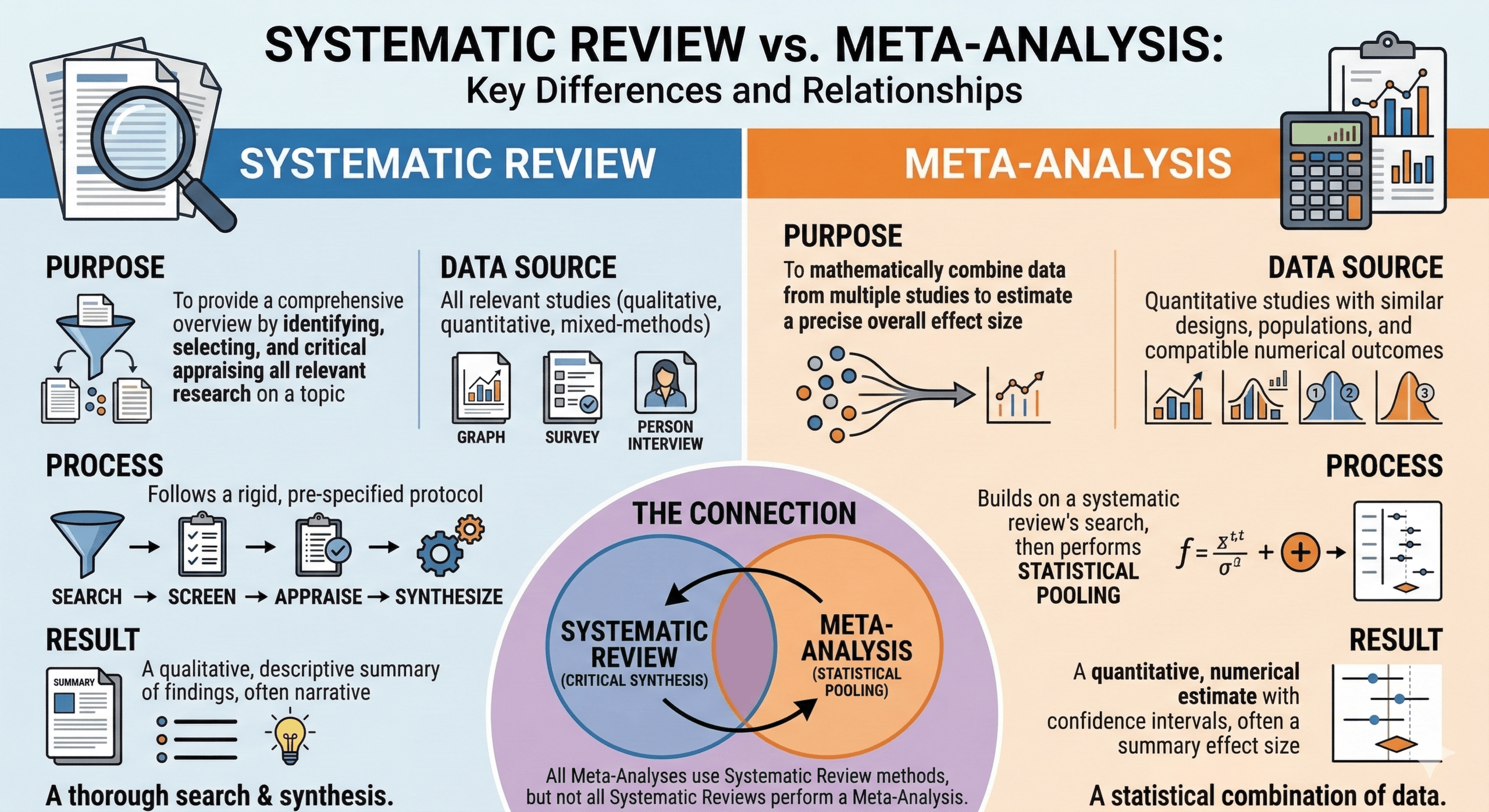
Systematic Review vs Meta Analysis: Key Differences Explained
If you have been doing research, you may have come across both of these terms. Many researchers, students, and professionals use them as if they mean the same. But they do not.
The confusion is easy to understand. Both methods deal with existing research. Both are considered high-quality forms of evidence. Both are widely used in fields such as medicine, public health, and education. Because of this overlap, many people assume that they are the same thing or that one is simply another name for the other.
But that is not the case.
Both systematic literature reviews and meta-analyses are research synthesis methods. They both help you look at existing studies. But the way they work, the type of output they produce, and even the situations where you use them are quite different from each other.
Knowing the difference matters. It helps you choose the right method for your research. It also helps you read and understand published research papers with much more clarity.
This blog will clearly explain the differences between a systematic literature review and a meta-analysis so that you will never confuse the two again.
What is a Systematic Literature Review?
A systematic literature review is a structured way of collecting, evaluating, and summarizing all available studies on a specific research question. It follows a clear and planned process from start to finish.
The main goal is to bring together all relevant evidence on a topic in an unbiased and repeatable way.
Key Characteristics of a Systematic Literature Review
- It follows a predefined protocol before the review begins
- It uses clear inclusion and exclusion criteria to select studies
- The synthesis is qualitative or descriptive (it may or may not include statistical analysis)
- It covers a wide range of study types
Want to know more? To learn more, read our detailed blog on What is a systematic literature review for a full breakdown.
What is a Meta Analysis?
A meta-analysis is a statistical technique that combines the numerical results of two or more similar studies. It goes beyond just describing the evidence and produces a single pooled result.
The main goal is to give a more precise estimate of an effect than any one study can provide on its own.
Key Characteristics of a Meta Analysis
- It uses quantitative (numerical) data from multiple studies
- It produces a pooled effect size, such as an odds ratio or mean difference
- It requires studies to be comparable enough to combine
- Results are often shown using a forest plot
Want to learn more about this method in detail? Check out our blog on What is Meta-analysis for a complete guide.
Systematic Review vs Meta Analysis: Key Differences
Now let us look at how these two methods are different from each other.
A. Definition Difference
A systematic literature review is a research method. It is a full process of searching, selecting, and summarizing studies. A meta-analysis is a statistical technique. It is a calculation method used to combine numbers from different studies.
B. Purpose Difference
A systematic literature review aims to summarize what the research says about a topic. A meta-analysis aims to calculate a combined numerical result from several studies.
C. Nature of Analysis
A systematic literature review produces a qualitative or descriptive summary. A meta-analysis produces quantitative and statistical results.
D. Data Requirement
A systematic literature review can include many types of studies, including qualitative studies. A meta-analysis requires quantitative studies, which are studies that have numerical outcome data that can be combined.
E. Dependency
A systematic literature review can be completed and published without a meta-analysis. In contrast, a meta-analysis always requires a systematic literature review to be conducted first to identify the studies to be combined.
Difference Between Systematic Review and Meta Analysis
| Feature | Systematic Literature Review | Meta-analysis |
| Definition | A structured method to identify, evaluate, and summaries all relevant studies | A statistical technique that combines results from multiple studies |
| Objective | To summaries and synthesise existing evidence | To calculate a single pooled estimate of effect |
| Type of Synthesis | Qualitative or descriptive | Quantitative and statistical |
| Data Used | Can include various study types, qualitative or quantitative | Needs comparable numerical data from studies |
| Outcome | A narrative or thematic summary of evidence | A pooled effect size or estimate |
| Can Stand Alone? | Yes, it can be published without meta-analysis | No, it needs a systematic literature review as its base |
When to Use Systematic Review vs Meta Analysis
Selecting the right method depends on your research question and the data available.
Use a Systematic Literature Review Only When
- The studies on your topic are too different to combine statistically
- You want to explore trends, themes, or gaps in the research
- The available studies include qualitative data that cannot be turned into numbers
- You want a broad picture of what the research says on a subject
Use a Meta Analysis When
- Multiple studies have measured the same outcome using numbers
- The studies are similar enough in design and population to compare
- You need a precise estimate of the size of an effect
- You want to resolve conflicting results between studies
Use Both Together When
- You want to first collect and appraise all the evidence (systematic literature review), and then statistically combine the results (meta-analysis)
- This is the most common and recommended approach in medical and health research
Are Systematic Literature Review and Meta Analysis the Same?
No, they are not the same.
This is one of the most common points of confusion in research methodology. Here is a simple way to understand the relationship between these two:
- A systematic literature review is a complete research process. A meta-analysis is just one step in addition to that process.
- Every meta-analysis requires a systematic literature review behind it. However, not every systematic literature review requires a meta-analysis.
- A systematic literature review can be conducted alone. A meta-analysis cannot exist without a prior systematic review of the literature.
- Think of it in this way: a systematic literature review is the foundation. Meta-analysis is an optional statistical step built on top of this foundation.
Conclusion
Systematic literature reviews and meta-analyses are valuable tools in evidence-based research. A systematic literature review provides a thorough and structured summary of existing studies. A meta-analysis takes this a step further by statistically combining numbers to produce clearer results.
The key difference in one sentence: a systematic literature review summarizes the evidence, whereas a meta-analysis statistically combines it.
Understanding this difference will help you choose the right method for your research and read the published studies with more clarity and confidence.
Ready to Elevate Your Research?
Accelerate your research success with Yonnova Scientific Consultancy. Whether you need guidance with systematic literature reviews and/or meta-analysis, our expert team supports students at every stage with quality, originality, and timely delivery.
Get personalized support, transparent communication, and proven publication success.
FAQs
1. What is the difference between systematic review vs meta-analysis?
A systematic literature review is a structured method of collecting and critically analyzing all relevant studies on a topic. A meta-analysis is a statistical technique used within a systematic literature review to combine numerical results. In short, a systematic literature review summarizes the evidence, whereas a meta-analysis calculates the pooled results.
2. Can a meta-analysis be done without a systematic literature review?
Technically, yes, but this is not recommended. A proper meta-analysis should be based on a systematic search and selection process to avoid bias. Without a systematic literature review, the results may lack transparency and reliability.
3. Are all systematic reviews includes meta-analyses?
No, not all systematic literature reviews include meta-analyses. Some systematic literature reviews provide only qualitative syntheses when statistical pooling is not possible. Meta-analyses are optional and not mandatory.
4. Can I do a systematic review without meta-analysis?
Yes, a systematic literature review can be conducted without performing a meta-analysis. This usually occurs when studies are too diverse in design, outcomes, or data reporting. In such cases, the findings are summarized descriptively.
5. When not to use a meta-analysis?
A meta-analysis should not be conducted when the studies are highly heterogeneous, lack sufficient numerical data, or have poor methodological quality. Combining incompatible studies can produce misleading results.
6. How to tell if an article is a systematic review or meta-analysis?
Often, articles mention both in the title. However, to identify a systematic literature review, check the methods section for a structured search strategy, inclusion criteria, and a PRISMA flow diagram. If a study includes statistical pooling, forest plots, and effect size calculations, it is a meta-analysis.