Identifying Hijacked Journals: The Case of JZU Natural Science Journal
Learn to identify hijacked journals like JZU Natural Science Journal and protect your research.
Every researcher faces one important question before starting their work: “Has this already been studied?”. While finding a research gap is the foundation of meaningful research, ensuring that your findings are published in a legitimate peer-reviewed journal is equally critical to your academic career.
Recently, the academic community has raised alarms regarding a suspected hijacked version of the Journal of Zhengzhou University-Natural Science Edition (often referred to as JZU Natural Science Journal), currently operating under the suspicious URL: https://naturalscience.pro/.
At Yonnova Scientific Consultancy, we help researchers at every stage of their journey, from identifying literature gaps to securing publication in PubMed, Scopus, SCI/SCIE, and Web of Science-indexed journals. In this guide, we break down how to spot hijacked journals and protect your intellectual property rights.
What is a Hijacked Journal?
A hijacked journal is a fraudulent website created to mimic a legitimate academic publication. These “clone” sites often steal the title, ISSN, and reputation of a real journal—frequently one that is print-only or lacks a strong web presence—to trick authors into paying high fees for “guaranteed” publication.
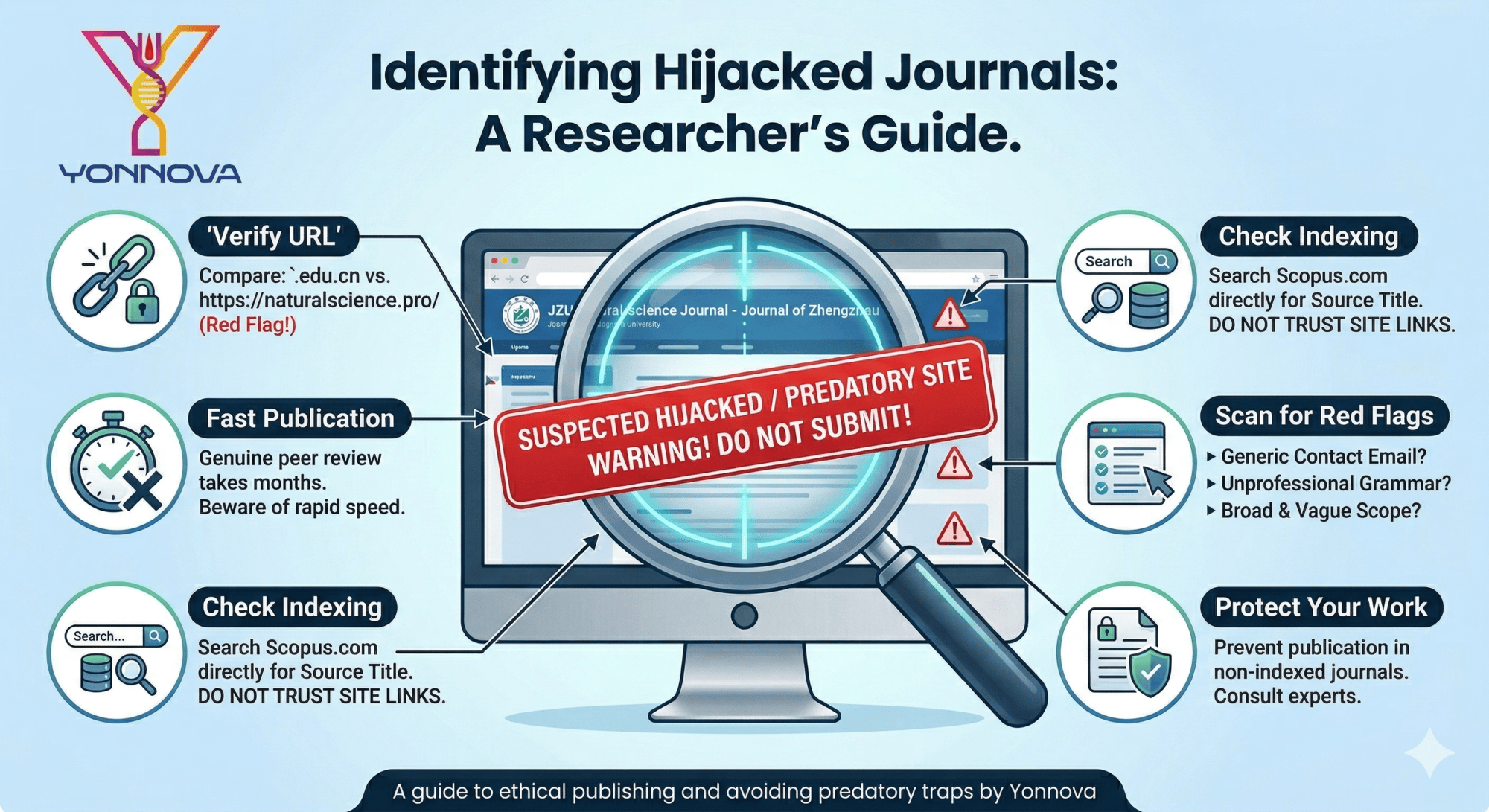
Red Flags: JZU Natural Science Journal (naturalscience.pro)
The legitimate Journal of Zhengzhou University is a respected institution, but the site at naturalscience.pro exhibits several classic predatory characteristics:
- Non-Institutional Domain: Most legitimate Chinese university journals use edu.cn extensions. A .pro or .com domain is a major red flag for state-affiliated publications.
- Broad Scope: While a real journal usually has a specific focus, hijacked sites often claim to accept papers in all fields to attract more “customers.”
- Rapid Publication Promises: High-quality peer reviews take time. If a journal promises to publish your work in a matter of days, it is likely skipping the review process.
- Formatting Irregularities: These sites often have grammatical errors or unprofessional layouts that do not match the prestige of the universities they claim to represent.
Other Similar Hijacked or Predatory Journals
The JZU case is part of a larger trend targeting reputable Asian and Middle Eastern journals. Researchers should exercise extreme caution with sites claiming to represent the following:
- Journal of Xi’an Shiyou University (Natural Science Edition): Frequently cloned by third-party sites seeking to collect “Article Processing Charges.”
- Wutan Huatan Jiexi: A journal whose identity has been used by multiple fraudulent websites to publish English-language papers unrelated to its original scope.
- Journal of University of Shanghai for Science and Technology (JUSST): Another common victim of digital hijacking.
How to Protect Your Research
Publishing in hijacked journals can lead to your work being “lost” to the academic world, as legitimate databases will not index these fraudulent sites. The following steps can be followed to verify a journal’s authenticity:
1. Verify the Indexing
Always check the journal directly on the official indexing platforms. For example, if a journal claims to be in Scopus, visit Scopus.com and search for the source title or ISSN yourself. Do not click on the links provided on the journal’s website.
2. Check the “Future Research” and “Limitations” Sections
If you are citing papers from a journal to find your own research gap, ensure that the source is credible. Predatory journals often publish low-quality work that lacks the “Language Cues” and rigorous “Methodology” found in reputable journals.
3. Consult the Experts
If you are unsure where to start or feel stuck in the publishing process, you do not have to go through it alone. Professional scientific consultancy services can provide a detailed review of a journal’s history and legitimacy.
Conclusion
Identifying a research gap is where your work begins, but choosing the right journal is where your work gains legacy. Avoid the trap of hijacked journals, such as the suspicious JZU Natural Science Edition site. Frame your research with precision, read widely with purpose, and always verify the platform on which you choose to share your findings.
Frequently Asked Questions (FAQs)
1. What exactly is a hijacked journal?
It is a fraudulent website created to look like a legitimate academic journal that scams researchers out of publication fees.
2. Is the JZU Natural Science Journal on naturalscience.pro legitimate?
Current evidence suggests that this specific URL is a hijacked/predatory clone and is not the official portal of the Journal of Zhengzhou University.
3. How can I find a legitimate research gap for publication?
Start with a thorough literature review, read the “limitations” of existing studies, and look for “unanswered questions.”
4. What are the common types of research gaps?
The main types include literature, contextual, methodological, contradiction, and practical/clinical gaps.
5. Can Yonnova help me identify a journal and a research gap?
Yes. Yonnova Scientific Consultancy supports researchers from topic selection and identifying gaps to final publication in indexed journals.
6. Why does the “Future Research” section matter for gap-finding?
Authors often use this section to provide “direct hints” about where the next research opportunity lies and what has not yet been studied in the field.